ICUC
- What
- A system that lets two people in augmented-reality glasses see where the other is looking in the same room.
- Why
- Speech and pointing are thin instruments for singling out something far away, and the moment you look at a handheld device you look away from the site.
- How
- Using HoloLens 2 it measures each person's eye and head direction, finds the moment their regions of interest coincide, and outlines that target in both headsets at once. Built in Unity (C#), sharing a coordinate frame through Azure Spatial Anchors and replicating state over Photon Unity Networking.
- New
- Rather than showing gaze continuously it shows it only where two people's attention meets, so the cue itself signals agreement.
Abstract
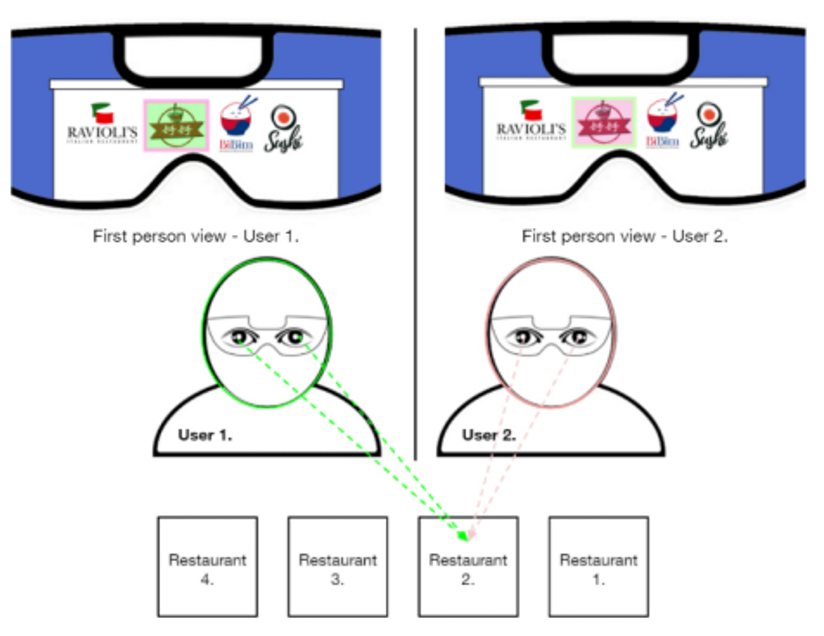
We propose a new system that provides an effective real-time interaction utilizing a novel attention cueing method regarding distance-based interaction in a possible collocated AR environment. Describing and sharing one’s interest upon certain distant objects to the others is one of the most common interactions in a collocated environment. Meanwhile, due to the limited efficiency and information bandwidth from traditional methods (e.g., verbal communication and pointing gestures), many services have been developed to provide location and its contextual information to users, in the form of social networks and online maps (such as the ones provided by Naver or Google). However, the shift of attention from the physical surface to a hand-held digital device inherently generates Information Access Cost (IAC) by its nature, which reduces efficiency in the process of information acquisition. Furthermore, collaborative interactions with personalized hand-held devices, by which users are obliged to notify each one’s interest towards real-world objects to the respective individuals in vicinity, is technically limited regarding the gap between the virtual space and the physical world. So far, numerous studies have utilized gaze visualization to improve interaction performance in collaborative environments. In addition, recent studies have started to acknowledge the importance of considering context-awareness not only for augmenting selected target’s information, but also for the gaze cue visualization. On the other hand, interaction techniques efficiently benefiting from gaze cues are yet to be deeply studied. Therefore, this project investigated the novelty of spatial information augmented in a HoloLens 2 device based on each user’s eye and head position; once two users reach a common region of interest, a notification in the form of square stroke upon the target is projected to the Hololens 2.